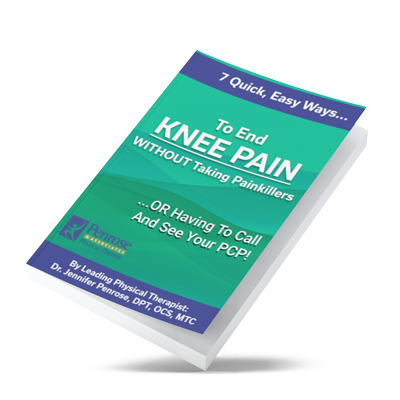


If you’re dealing with knee pain, you’re not alone.
Every week at Penrose Physical Therapy, we meet people who say some version of the same thing:
- “It started as a small ache.”
- “It only hurts when I go up stairs.”
- “It’s fine unless I try to run.”
- “I thought it would go away.”
And sometimes it does.
But more often, it lingers. It changes. It spreads. It starts limiting things you used to do without thinking.
The real frustration is not just the discomfort. It is the uncertainty.
Is this arthritis?
Did I tear something?
Am I making it worse by staying active?
Should I just rest it?
Here’s the truth.
Most knee pain is not random. And most knee pain is not permanent.
But it does require the right approach.
The Knee Is Rarely the Whole Story
Your knee is a hinge joint. But it is not a simple hinge.
It sits between two powerful segments of your body: the hip and the ankle. If either of those areas is not doing its job properly, the knee absorbs the stress.
That means:
- Tight hips can overload the front of the knee
- Weak glutes can cause the knee to collapse inward
- Limited ankle mobility can strain the patellar tendon
- Poor movement mechanics can irritate cartilage or ligaments
This is why knee pain often keeps coming back.
The pain location is not always the true source of the problem.
At Penrose Physical Therapy, when someone comes in for knee pain treatment, we do not just look at the knee. We assess:
- Hip strength
- Ankle mobility
- Walking mechanics
- Squat and step patterns
- Load tolerance
- Activity history
Because if we only treat symptoms, you might feel better temporarily. But if we address root causes, you improve long term.
The Most Common Types of Knee Pain We See
Patellofemoral Pain Syndrome
Often described as pain around or behind the kneecap.
Common in:
- Runners
- Active adults
- Teens
- People who sit for long periods
It typically worsens with stairs, squatting, prolonged sitting, or downhill walking.
This is rarely a “damage” issue. It is usually a load management and strength imbalance issue.
Meniscus Irritation
You might feel:
- Catching
- Clicking
- Sharp pain when twisting
- Swelling
Not every meniscus issue requires surgery. Many respond very well to structured physical therapy and progressive strengthening.
Knee Osteoarthritis
Arthritis does not automatically mean decline.
Yes, cartilage changes over time. But pain is influenced by far more than imaging. We have seen countless people with arthritis improve mobility, strength, and confidence without injections or surgery.
Movement done properly is medicine for arthritic knees.
Tendon Pain
Patellar tendon irritation is common in:
- Jumping athletes
- Active adults returning to workouts
- People who increase activity too quickly
Tendon pain responds to progressive loading. Not total rest.
Why Rest Alone Usually Does Not Work
When your knee hurts, the natural instinct is to rest.
Short term rest can help calm irritation.
But long term rest creates a new problem:
- Muscles weaken
- Stability decreases
- Joint tolerance drops
- Confidence fades
Then when you return to activity, the knee flares up again.
The goal is not to avoid movement.
The goal is to restore capacity.
Your knee needs to become stronger than the demands you place on it.
That is what structured knee pain treatment should do.
The Mental Side of Knee Pain
When knee pain lingers, people start to second guess every movement.
They hesitate on stairs.
They avoid kneeling.
They skip workouts.
They feel older than they are.
Over time, fear of pain becomes just as limiting as the pain itself.
Research shows that confidence and load tolerance improve together.
When your knee becomes stronger, your trust in it returns.
At Penrose Physical Therapy, we do not just focus on tissue healing. We focus on restoring confidence.
Because confidence changes how you move.
What Effective Knee Pain Treatment Should Include
If you are searching for knee pain treatment, here is what you should look for:
A Thorough Evaluation
You deserve:
- Movement assessment
- Strength testing
- Mobility screening
- Activity analysis
- Clear explanation of findings
You should leave your first visit understanding what is happening.
A Progressive Strength Plan
Real change comes from progressive loading.
This includes:
- Glute strengthening
- Quad strengthening
- Hamstring balance
- Calf work
- Controlled single leg stability
The exercises should match your goals.
Walking pain free?
Running again?
Playing with your kids?
Returning to pickleball?
The plan must be specific.
Load Management Strategy
Too much too soon is one of the biggest causes of knee flare ups.
You should be guided on:
- How to scale activity
- When to push
- When to pull back
- How to increase safely
“But What If It’s Bone on Bone?”
Even when imaging shows cartilage loss, that does not mean you are doomed to pain.
Pain is influenced by:
- Inflammation
- Strength
- Load tolerance
- Nervous system sensitivity
- Sleep
- Stress
- Movement habits
We have seen people labeled “bone on bone” dramatically improve their function.
The knee is adaptable.
Your body is not fragile.
It responds to smart, progressive stimulus.
Strong Knees Mean Long Term Freedom
Strong knees are not just about sports.
They are about:
- Independence
- Confidence
- Mobility
- Quality of life
Being able to:
- Get up from the floor
- Carry groceries
- Walk long distances
- Travel comfortably
- Stay active with family
Knee health is freedom.
Ready to Get Answers?
You do not have to guess what is happening with your knee.
At Penrose Physical Therapy, we offer a Free Discovery Visit where you can:
- Share what has been happening
- Get expert insight
- Ask questions
- Learn your next best step
No pressure. No obligation.
👉 Schedule your Free Discovery Visit today and take the first step toward stronger, more confident knees.